
State of Mississippi Judiciary
Administrative Office of Courts
|
Former Justice Charles R. “Chuck” McRae presents portrait to Supreme Court January 6, 2026 Former Presiding Justice Charles R. “Chuck” McRae, surrounded by his family, presented his portrait to the Mississippi Supreme Court during a crowded ceremony on Jan. 5. 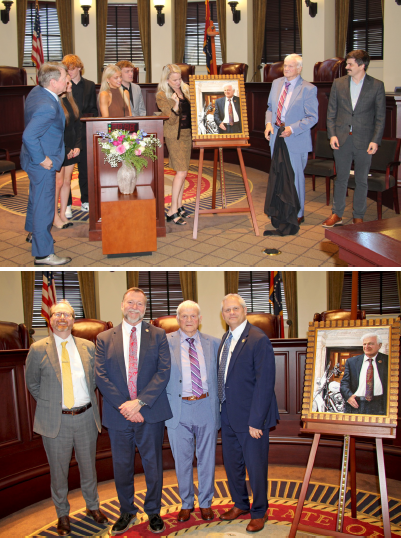
The painting portrays McRae in a business suit beside his Harley-Davidson motorcycle, with the Old Supreme Court Chambers of the New Capitol in the background. Though not painted from actual pictures he had taken while serving on the court, the portrait captures his essence. Some have criticized the motorcycle, said his daughter, attorney Rebecca McRae Langston of Southlake, Texas. “But riding always returned my father to his roots, the wind, to the earth, and to being fully himself. It is where he found his strength and his clarity..I believe that this portrait shows him as a distinguished jurist, grounded by humility, shaped by hard-ship and sustained by purpose.” Langston commissioned the portrait and donated it to the Supreme Court. The portrait will become part of the Supreme Court’s historic collection, which includes more than 40 portraits of justices who served from the 1800s to modern times. Artist Trevor Goring painted the portrait. He did not attend the ceremony. The British artist, who now lives in France, said in an e-mail that he has known McRae for at least 15 years. He has worked closely with the international trial lawyer community as an artist, conference speaker, author and consultant. Speaking of McRae, Goring said, “I have always admired his independence, his courage to stand up for individuals against corporate interests, his ability to bring opposing factions together, and his adventurous lifestyle.” McRae, who served on the Supreme Court for 13 years, from January 1991 through January 2024, said of the portrait, “It is unusual. As most of you know, my life, my reaction to life, is unusual. I am a product of my environment, public education and my street life.” He talked at length about successes, loss, regrets and the love and support of family and friends. McRae was born in Pascagoula, the youngest of four siblings. They were poor. He recalled his mother made feed sack shirts for him. He had one pair of shoes. His mother never rested. She knew how to stretch a meal. They ate fried SPAM, lima beans, rice and gravy, chicken and dumplings, and chicken on Sunday. She was a prayerful woman, a volunteer secretary at the Methodist Church. She died when he was 12. His father died when he was 15. He was a rebel by the time he became a teenager. McRae said he became embittered. “Nobody would control me after my mother died..I never could understand why God took my mother at the age of 48.. I became a rebel against life.” But he didn’t want anyone to think he had it rough, compared to his older siblings. He finished his junior year of high school in Pittsburgh, Pa., living at his friend Gary Casciola’s tiny house. The house was already crowded, but Gary’s mother Mary made room. Tina Williams’ family took him in during his senior year. When he was in college, friends and their families made sure that he had food. With the help of his friends and their families, it became “a charmed life.” He recalled a former girlfriend’s mother, who turned him around “from being a rebel against life to a rebel for life, and that’s where I stand.” Langston said, “Dad knew that he could either be swallowed by his circumstances, or become more than them, so he worked relentlessly.” He played high school football and attended Marietta College in Ohio on a scholarship. He taught and coached in high schools. He worked as an insurance adjuster and attended law school at night, graduating from the former Jackson School of Law, now Mississippi College School of Law, cum laude in two and a half years. Supreme Court Chief Justice Mike Randolph recalled the first time he saw McRae. Randolph was working at a law firm on the Gulf Coast, not long out of law school. Lawyers in the firm sent him to watch McRae try a case in U.S. District Court. “They said, ‘You’ll learn more at that court than you will anywhere else.’ ” McRae recalled the case, a personal injury lawsuit on behalf of a young child who had been severely burned. The record for largest jury verdict in Mississippi at that time was $125,000. The defendant offered $500,000 to settle. McRae refused and tried the case to verdict, where a federal court jury awarded the plaintiffs $800,000. Supreme Court Justice David P. Sullivan of Biloxi, Court of Appeals Judge Anthony Lawrence III of Pascagoula and Court of Appeals Judge David Neil McCarty of Jackson said that McRae has been an important mentor to them as well as numerous other lawyers. Justice Sullivan said that his late father, Presiding Justice Michael Sullivan, was the lone “character” on the Supreme Court until Justice McRae joined the court in January 1991. They were kindred spirits. “Justice McRae brought the street to the bench,” Justice Sullivan said. Other justices on the Supreme Court when McRae joined their ranks were Chief Justice Roy Noble Lee; Presiding Justices Armis Hawkins and Dan Lee; Justice Lenore Prather, the court’s first woman justice; Justice Fred L. Banks Jr., the court’s second Black justice; former law profes-sor James L. Robertson; and former attorney general Edwin Lloyd Pittman. “That is an extremely impactful and significant group of men and women who were diverse and made changes to the administration of justice and equality, and made improvements to the legal system that we are still feeling today,” Justice Sullivan said. McRae won election in a 1990 race that, with trial lawyer backing, was the highest spending campaign for the state Supreme Court at that time. “What he did and what he proved and what I learned from that, my last name notwithstanding, was that the people vote, not the establishment..Your last name or who your daddy was is a good start, but you have to get out there and connect with the people and do the work,” Justice Sullivan said. Justice Michael Sullivan died in office in 2000. He continued to work from a hospital bed until shortly before his death. Justice McRae visited him nearly every day, the younger Justice Sullivan recalled. “Because they were so close, he became somebody that later throughout life, through my ups and downs, I never made a career move without calling Chuck. I had a lot of personal situations that I would call him and run by him. He always steered me straight because he gave me the kind of advice that I feel like my dad would have given me.” He said, “I could not be more honored to stand here and honor my friend and mentor, Justice Chuck McRae.” Judge Lawrence said that during his second year of law school, McRae hired him as an intern in his Pascagoula law office. He recalled that McRae told him that law school taught one how to think and talk like a lawyer, but law practice taught one how to be a lawyer. And McRae made sure that his young colleague got plenty of practice. An elderly couple asked for help after losing their life savings in an oil drilling investment proposal pitched by a deacon in their church. McRae told Lawrence that he would “cut his teeth” on the case. For more than three years, they pursued every possible defendant in a case that had little prospect for recovery, but were eventually successful. McRae was “a protector of those who need help in our legal system,” Lawrence said. “He gave me a great start, and it was not just me. He did it for so many young lawyers when he served as their mentor,” Judge Lawrence said. He recalled hiring young lawyers himself as district attorney, and telling them what McRae had told him: “If you want to be a lawyer, have the courage to fight for your client, regardless of what others may think.” Judge McCarty as a private practice lawyer rented law office space from McRae in Jackson. Judge McCarty recalled that when he closed his law office after election to the court in 2018, he asked McRae for advice. His answer was, “Just try to do the right thing.” Judge McCarty said that Justice McRae authored 369 majority opinions during his service on the Supreme Court. But it was his passionate dissents that showed him as a fighter. McCarty recalled one such dissent. A chancellor had refused to give a father custody of his son. On appeal, the state Supreme Court re-fused a change in custody. Justice McRae in his dissent characterized the stepfather as an abusive, unemployed convicted felon, a wife-beater and adulterer who abused alcohol and drugs. The natural father had a good job, a stable home and did all that he could to support his child. “The only difference, the judge pointed out, was that the little boy’s father was gay..It didn’t matter to Chuck McRae whether someone was straight or gay, whether they were Black or White, whether they were wealthy or poor, and indeed our oaths as judges require us to look past those concerns of the world to the truth behind it. Do what is right. Not what we want to do, but what the law says..It took another 20 years for the U.S. Supreme Court to agree with the principle that Justice McRae had written in dissent.” The only other justice who joined McRae in that dissent was Michael Sullivan. “What set him apart was his blood, was his heart, a man who had literally run with the bulls in Pamplona – which I asked him not to do by the way because he does not have great knees,” Judge McCarty said. “I think Mississippi is better for having had a judge who bled and fought, who believed and stood his ground, but who believed the law wasn’t just precedent and statute, but our lives.” Video of the ceremony is archived at this link: https://vimeo.com/event/5629441. #### |